
FutureLearn Course Studio
Where advanced AI acceleration meets uncompromising human assurance.
Course Studio by FutureLearn is an innovative AI-driven platform that empowers universities to successfully diversify and scale their digital portfolios while maintaining the academic excellence and rigour their reputations demand. Through a storyboard-first workflow and precise editorial control, the platform turns module descriptors into structured storyboards and content, allowing academics and learning design teams to edit, approve, or modularly regenerate sections via granular editing tools and customisable AI voice-over layers.
The platform’s key features focus on academic compliance, authoring flexibility, future-proof delivery and accessibility by design. It’s foundationally compliant with WCAG 2.2 AA standards and incorporates robust data security measures like encryption, access controls, and auditability. This ethical, safe, and secure architecture is built to align with the UK’s pro-innovation regulatory framework while remaining highly scalable through a future roadmap that includes SCORM packaging, LMS agnostic integration, and adaptive learner analytics.
Intelligent automation meets expert insight
How does it work?
The workflow establishes an active, ongoing circle of continuous evaluation that extends well beyond initial course deployment. Once live, learners interact with the online material, the platform gathers precise learner analytics and qualitative user feedback to track operational performance and real-world student behaviours. This data feeds into routine performance reviews to extract actionable learning insights and design concrete improvement plans. Depending on the scope of the required modifications, maintenance loops route into minor fixes executed via swift patch releases, or cycle back entirely into Phase 2 or 3 for major enhancements and deeper modular regeneration.
Ready to transform your curriculum?
What makes Course Studio different?
Every Course Studio module is built to satisfy the UK Quality Code, FHEQ L4-L7, QAA guidance, and OfS expectations for technology-enhanced learning. By mirroring established workflows and translating raw institutional specifications into high-quality digital environments, the platform balances intelligent automation with rigorous academic oversight. This ensures that all generated educational offerings remain credible, secure, and fully compliant with evolving regulatory benchmarks.
The development process achieves this high standard through a series of structured quality checks and core design principles:

Human QA at every step
The development workflow strictly mandates human intervention and expert oversight at every critical milestone. Each of the five development phases requires explicit review, and accountability flows directly through designated quality gates before a module can progress.

Constructive alignment
Modules are developed directly from specific learning outcomes and descriptors. This outcome-aligned instructional design guarantees absolute academic rigour and establishes tight cohesion between the core content and student assessments.

Bespoke development
Content development follows a precise 1:1 mapping of the approved institutional module specifications, turning them into structured layouts. Faculty retain final editorial authority through granular editing tools, allowing them to customise layouts or modularly regenerate sections.
Accessibility by design
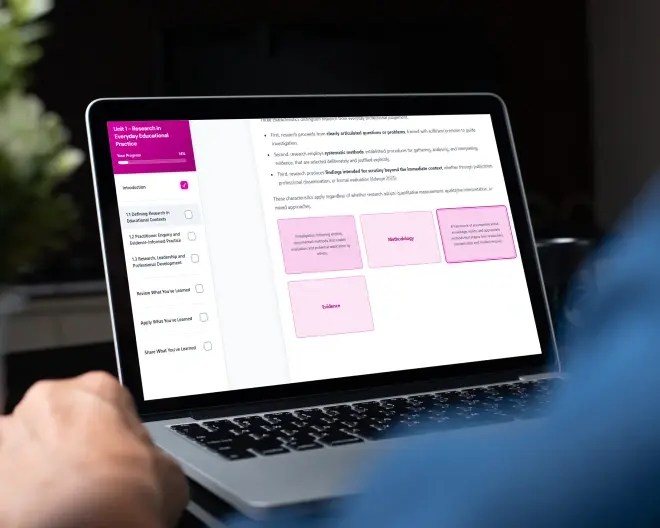
The platform is foundationally compliant with WCAG standards. It automatically structures semantic reading hierarchies, optimises overall text readability, and generates context-aware AI alt text for all visual imagery.

Academic integrity standards
To support a trustworthy and credible learning environment, the architecture embeds robust data security measures. This includes strict encryption, access controls, and explicit system auditability to align with ethical governance practices.

Continuous improvement loop
Post-deployment, the platform gathers precise learner analytics and qualitative user feedback to monitor real-world performance. These insights drive routine reviews, routing minor fixes into patch releases or cycling larger enhancements back into the design phases for ongoing iteration.
Ready to transform your curriculum?
AI-powered. Quality-driven. Human-assured.
Don’t let stagnant funding or slow development pipelines hold your institution or organisation back from vital growth. Course Studio by FutureLearn provides a structured, trustworthy framework where cutting-edge technology and human expertise work in perfect harmony. By choosing Course Studio, your institution gains a deeply reliable, future-proof partner committed to translating complex curriculum specifications into world-class, accessible learning experiences that confidently uphold your university’s reputation. Empower your team today and discover how Course Studio can help your organisation build a sustainable, world-class foundation for global digital education.
Fill out the form to get in touch
With fixed pricing models and quality assurance at every level, you can start building your curriculum right away.