Having spent the past three years refocusing and streamlining the business to offer a wider range of services with broader, deeper market reach, over the next five years FutureLearn aims to become the ‘go-to’ lifelong learning partner for higher education partners, corporates, charities, governments and also individual learners. Harnessing digital and AI-driven innovation with integrity, making an impact by equipping individuals with the skills and experience employers need.
With over 22 million learners since its creation as a MOOC platform, and with hundreds of current partners, FutureLearn’s strategy is to grow by working with strategic partners across the sector and across geographies, deepening engagement with current partners and extending reach into new areas.
FutureLearn is committed to good governance and integrity, quality assurance and providing education services driven by FutureLearn’s purpose.
Vision
To redefine digital learning by developing our services and products across academic, professional and vocational. Extending our global reach.
To elevate our learner experience with tech-driven, agile responsive interaction, creating cutting-edge, tailored lifelong learning responses.
To lead the way in content-driven, career-focused solutions. Leveraging tech and market-driven insights to become the full service ‘go-to’ lifelong learning partner.
Purpose
To partner with the world’s leading educators to support individuals and organisations in addressing skills gaps with flexible, personalised, career-transforming learning.
Academic Governance
FutureLearn’s formal governance structure supports the assurance of academic integrity, strategic decision-making, and accountability. It is designed to promote a culture of transparency, collaboration, and effective academic leadership.
The structure supports the development, approval, and implementation of academic policies, upholds academic integrity, and promotes collaboration across departments, producing a well-governed, responsive, and high-performing academic directorate. By clearly defining roles and responsibilities, it facilitates effective leadership and efficient resource management. Additionally, it ensures that academic programmes align with institutional goals.
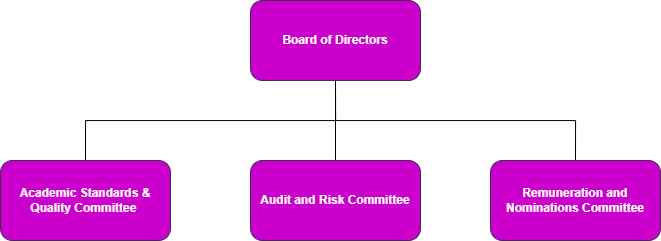
Board Structure
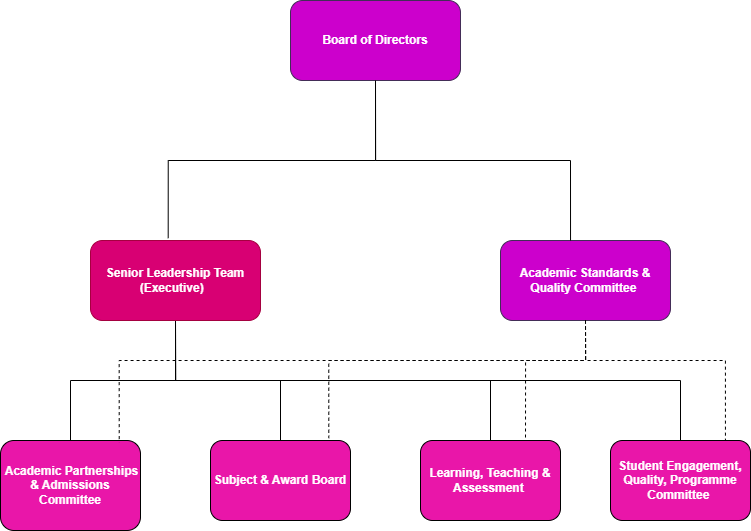
Academic Governance Structure
Within the academic governance structure there is one governance committee and 4 sub academic committees. Each committee has clear terms of reference which set out its scope and authority. The Academic Standards and Quality Committee (the governance committee) is independently chaired by an independent Board Director. The 4 sub academic committees report to the FutureLearn senior leadership team.
FutureLearn’s Academic Standards and Quality Committee is a committee of the Board of Directors and has delegated responsibility from the Board for FutureLearn’s academic provision, quality, enhancements, partnership and academic collaborations. It also supports the Board with ensuring compliance with the Office for Students Conditions of Registration. The Academic Standards and Quality Committee has delegated authority from the Board to approve academic policies, oversees academic portfolios, curriculum design and review, student experience and outcomes in accordance with regulatory requirements. The Committee evaluates the performance of FutureLearn’s programmes, learner recruitment, learner performance, teaching quality, support, research, and staff development. It ensures access to education, academic fairness, and integrity. The Committee oversees strategic academic planning and resource allocation and ensures a culture of active continuous improvement.
The four sub committees report to the Senior Leadership Team and with a dotted line to the Academic Standards and Quality Committee. Their respective terms of reference are set out below.
A Subject and Award Board is run after each assessment period.
The purpose of this Board is to oversee the academic quality and standard of all modules, ratifying marking and moderation for an assessment period. The Board reviews student performance, module performance, and external examiner reports to inform continuous improvement. It reviews student conduct and appeals to ensure fair and impartial handling of academic matters, including cases of academic misconduct, appeals and extenuating circumstances. The Board is responsible for confirming student progression, module results, and final awards in accordance with institutional regulations.
The Academic Partnerships and Admissions Committee is responsible for ensuring quality partnerships are maintained with UK and overseas partners. The Academic Partnerships and Admissions Committee will assess the opportunities and risks of new and ongoing partnerships and make recommendations to the Academic Standards and Quality Committee on the approval or continuation of partner arrangements. The Academic Partnerships and Admissions Committee ensures fair, transparent, and consistent admissions decisions are aligned with organisational standards and strategic goals. The committee reviews the level of entry requirements and compliance of these across all programmes, including ensuring marketing materials are up to date and reflective of the validated requirements. In addition, it reviews student forecasts and actual enrolments. It advises applicants and staff on all matters relating to entry onto the programmes. The committee also reviews and refines admissions procedures to support diversity, inclusion, and accessibility.
The Learning, Teaching and Assessment Committee oversees the quality, effectiveness and enhancement of FutureLearn education. It provides strategic oversight and guidance on curriculum development, teaching methods, and assessment strategies to ensure alignment with academic standards. The committee promotes collaboration among faculty and supports professional development initiatives.The committee takes responsibility for monitoring ethics and integrity across its entire provision and ensuring the ongoing compliance of legislative and regulatory matters. It also underpins and assures FutureLearn’s position on guaranteeing equitable access to education regardless of background or circumstance.
The Student Engagement, Quality and Programme Committee is central to FutureLearn’s commitment to maintaining quality across its entire provision and ensuring the ongoing compliance of legislative and regulatory matters. The committee will formulate and recommend new policies to the Academic Standards and Quality Committee for approval around quality assurance that meet sector standards. The committee approves validations, and major modifications to programme structures and content. The committee will advise the Academic Standards and Quality Committee on programme closures and any risks associated with teach-out. The student voice system feeds into this committee providing the link between representatives from programmes and senior management at FutureLearn. The Student Engagement, Quality and Programme Committee is responsible for overseeing the development, quality, and relevance of the course and programme offerings. It ensures that courses align with educational goals, maintain academic integrity, and meet learner needs. Additionally, the committee advises on programme and course directions, promotes inclusivity and accessibility, and fosters continuous improvement. Student representatives provide feedback on their specific programmes and comment on the learner experience, teaching quality and resources.